Sunday, June 17, 2012

Homebrew, Take 2

Earlier this year, I wrote about my first experience trying a homebrew: an Irish Chocolate Stout made by my neighbor, Matt. A few months later, I had the pleasure of trying another round of homebrews.

The first is a Chocolate Almond Milk Stout, also made by Matt.


5.0-5.5% ABV; 31-34 IBU
Appearance: Opaque brown with caramel-colored head
Smell: Sweet alcohol - definitively stout
Taste: At first sip, it was a subtle flavor. As I continued drinking, I noticed it was light on chocolate, was "milky", and had a great stout flavor.
Mouthfeel: Medium; fizzy with a kick of carbonation.
Overall: Subtle flavor in an excellent stout. Maybe a little too much carbonation but a very good brew.


The second is an IPA, made by Matt's father-in-law.


I don't know the specs on this one, but I'd guess it's a sessionable beer, maybe 4.0-4.5% ABV.
Appearance: Orange hazy hue with a thick, off-white, frothy head.
Smell: The familiar comforting smell of hops, sweet and inviting.
Taste: At first sip, it was inviting and very drinkable. As I continued drinking, I noticed that there was a somewhat low bitterness factor. It was smooth and easy to drink with a welcome little kick. Possibly a hint of orange. A slightly bitter aftertaste, appropriate for an IPA.
Mouthfeel: Medium; smooth; definitely not thin.
Overall: Not as kicky of an IPA as I expected, but a great spot-on flavor.


I'm wondering what homebrews my readers are working on these days. Share your beery creativity by:
  1. leaving a comment below
  2. Tweeting @BrewReviewMann
  3. circling Justin's Brew Review on Google+
  4. find Justin's Brew Review on Facebook
  5. sending an email to JustinsBrewReview@gmail.com
Blogging about beer is fun, and I'd really love to have some two-way conversations with other beer lovers. Prost!


Sunday, June 10, 2012

Boulder Beer's "Hazed and Infused"


I'm going to attempt to chip away at my backlog of tasting notes and begin blogging about some of the beers that I have tried over the last few months (or year).

Today, we have Boulder Beer's "Hazed & Infused". As you may have guessed from the brewery's name, this amber ale comes to us from Colorado. Boulder Beer's website tells us that they are Colorado's first microbrewery (opened in 1979), receiving the 43rd brewing license issued in the United States. The founders, "Hummer" and "Stick", first opened the brewery in a goat shed. They have, of course, expanded since then, and I can assure you that their beer doesn't taste like goats! You can take a virtual brewery tour on their website.

Back to the beer, "Hazed & Infused" weighs in at 4.85% ABV and is infused, or dry-hopped, with Crystal and Centennial hops. This is in addition to the Nugget, Willamette, Crystal, and Centennial hops used to brew the beer. "Hazed" was a "one-keg" experimental brew (often the best kind!) from 2001, but it was so popular with those who tried it that it became a mainstay.

"Hazed & Infused" definitely had a hazy appearance, evidence that it is, in fact, an unfiltered beer. It had a sweet fruity smell with an undertone of bitter hops. Though the hops were also evident in the flavor, the taste wasn't too bitter. It had a nice citrus fruit flavor and was very refreshing. "Hazed" makes for a good summer beer and is, in a word, "fun".

BeerAdvocate users give it an 85 (824 reviews), and the Brothers give it a 78.
RateBeer users give it an 89 overall and a 91 for style (1116 reviews).
Justin's Brew Review gives it an A-.

Wednesday, June 6, 2012

Dogfish Head Craft Brewery Tour

DFH's $30,001 Steampunk Treehouse
Last week, I had the pleasure of visiting Dogfish Head Craft Brewery in Milton, Delaware. My wife and I, along with our dog, made the trip down to the Delaware beaches. Incidentally, if you're looking for a good place to stay in Lewes, we highly recommend the Lazy L at Willow Creek, a very dog-friendly bed & breakfast.

Before I talk about my experience at the Dogfish Head (DFH) facility, I should tell you about my preconceived notions. I have always viewed DFH as a tree-hugging, peace-loving, far-out-there kind of brewery. Their slogan proves my prejudicial bent: "Off-centered stuff for off-centered people". Also, the names of some of their beers are pretty inaccessible: Raison D'Etre, Palo Santo Marron, Burton Baton, Festina Peche, Chateau Jiahu, Namaste, Sah'Tea, and Ta Henket, to name a few. I am not against things that are "different", and I certainly don't mind creativity. Yet, DFH just didn't seem to be up my alley.

Of course, none of this would keep me from taking a brewery tour! I always find it fascinating to hear about the history of a brewery, see the operations, watch the bottles go clinking down the line, and of course, sample the wares. And I have to admit that by the end of the tour, I realized that DFH was not as inaccessible as I had once thought.

Sam Calagione: the man, the myth, the legend. (Nice looking beer!)
Sam Calagione, founder and President of DFH, was an English major (like yours truly!) and, according to the DFH website, is the "brainchild behind all the wacky things that happen at Dogfish Head" [1]. The tour guide said that Sam decided to open DFH in Delaware because 1) his wife grew up there and 2) at that time, there were no DE breweries [2], so he could help to shape the beer laws. Sam must have done a pretty good job shaping the DE beer laws, because I'm happy to report that I was able to pick up some beers tax-free and in stores that sell wine, spirits, and beer all in one place [3].

Some of the original beer-making equipment
One of the stories our tour guide told us was about payday beer. As with all production ventures, things inevitably go wrong sometimes. So there are some batches of beer that just aren't, let's say, optimal. But it's still beer, so why let it go to waste, right? That's what the DFH employees thought too! So they would go in search of the "bad" beer and take it home with them. This became such a popular pastime that Sam implemented the payday beer. Now, employees are afforded the opportunity to specify which one of a few beers they would like to have, and it is delivered to them along with their paycheck every other week. I can imagine that DFH employees have a lot of friends wanting to visit every couple of weeks. Also, just think of how many disgruntled employees would change their tune if they got payday beer (hint to corporate America).

Another story that our tour guide told us was about the treehouse in front of the DFH brewery (pictured at the top). The Steampunk Treehouse was first exhibited at the 2007 Burning Man festival in Nevada and now permanently resides at DFH. (Read more here.) Sam bought it at an auction for $1, but it cost another $30,000 to ship and install. So the deal was a bit more than Sam "bargained" for (insert canned laughter here), but it yields a sweet first impression for DFH visitors.

"Where's the tap on this thing?"
The namesake of one of DFH's brews, Palo Santo, is actually a type of wood that only grows in one place on earth: Paraguay. Palo Santo, meaning holy wood, is used to condition DFH's brown ale and gives it a caramel vanilla flavor (mmm!). Interestingly, this wood is so tough that even a bullet doesn't damage it. As a matter of fact, the large tank pictured above is made of Palo Santo wood, and the craftsmen went through  seventeen diamond-tipped saw blades to make it. I cannot imagine enduring such a painstaking effort. But at least the beer is good!

A note about the 60 Minute, 90 Minute, and 120 Minute IPAs that DFH makes. Hops are added for flavor and are typically introduced to the beer at the beginning and end of the brewing process. Our tour guide told us that, one day, Sam was watching a cooking show. The chef was adding pepper to the recipe all throughout the cooking process because adding it all at one time would ruin the flavor. This "aha!" moment led to Sam's "Sir Hops Alot" contraption. Basically, he rigged a vibrating base to shake hops down into a bucket with holes in it. As "Sir Hops Alot" continued its vibrating endeavors, the hops would find their way out of the bucket and into the brew. (They have since refined the machinery, but this basic innovation got the job done!) This led to a continuous hopping process, thereby exponentially increasing the robust flavor of the beer. The 90 Minute, for example, is continuously hopped in this manner for 90 minutes. Genius!

From DFH's Rehobeth brewpub
And now for the sampling! During the tour, DFH was licensed to provide 12 ounces of beer to visitors for free. DFH decided to split that 12 ounces into four 3-ounce samples. I was privileged to try Festina Peche (peach-flavored, not a favorite of mine), 60 Minute IPA (an excellent IPA), Burton Baton (wow! amazing imperial IPA!), and Palo Santo Marron (a wonderful brown ale). Later on, we also visited DFH's brewpub in Rehobeth. There I sampled five brews:
  1. Sah' Tea -- Wow, spices galore! It's like Chai tea in a beer. I think you would have to be in the right mindset to drink this and maybe only one at a time. Very unique. I'm impressed.
  2. Indian Brown Ale -- Hits the style on the nose! Has a little extra spice, hence the "Indian", I suppose.
  3. Aprihop -- Lighter than I expected. A good apricot flavor. Easy to drink and refreshing at the same time.
  4. Midas Touch -- From the taste, this is what I would call a "normal" beer. However, it is slightly differentiated by the higher alcohol content (9%) and extra "bite".
  5. Tweason'ale -- Pretty good. I couldn't identify what "extra" flavor I was picking up on in this beer, but after reading  the notes on BeerAdvocate, I believe it was the sorghum and molasses.
I walked away with a four-pack of Burton Baton, one 750-ml bottle of Urkontinent (the DFH-Google(!) collaboration brew), and two pints of the extremely-hard-to-come-by 120 Minute (I paid $9 per pint, but it's not unheard of to pay $13 or more for a pint!).

If you are planning on taking a DFH brewery tour (and you should), make sure you reserve a spot in advance. You can do so on DFH's website.

----------------------
Footnotes:
[1] One of Sam's "wacky" ideas was to brew a naturally-green beer using Spirulina (seaweed) in an attempt to thwart the obviously-evil plot to cheapen his beer by using green dye for St. Paddy's day. (Read DFH's take on it, and check it out on BeerAdvocate.)
[2] According to BeerMe.com, there are still only eleven DE breweries currently in operation with one in the works.
[3] Don't even get me started on the odd setup we have in Pennsylvania! But please feel free to visit Lew Bryson's blog "Why the PLCB should be abolished" at http://noplcb.blogspot.com/.


Friday, May 11, 2012

Back to the Brew-ture

It has been quite some time since my last blog post. If you already knew that without me telling you, then I owe you an apology. I just finished what was undoubtedly the hardest semester of my post-graduate coursework, and this Saturday, I will be walking across the stage to receive a Master of Business Administration degree. It was a rather enjoyable ride, and at the same time, I'm glad it's done. Time to get back to living life again. Also, time for some brew-reviewing!

As I alluded to in my last post, even though I haven't blogged in a while, I haven't stopped sampling the brewski. Today's sampling comes from our recent trip to Victor's Italian Restaurant in York, PA[1]. First on tap today, we have my first Sun King beer, Ring of Dingle, which is a 4.7% ABV dry Irish stout. Coming to us from Indianapolis, this stout was very smooth to drink, as a stout should be. Regarding the flavor: what can I say but wow! This amuse bouche was a delight, even with the bit of a bite in aftertaste. I'd drink it again. Surprisingly, there are no ratings on BeerAdvocate or RateBeer at this time.

For being a "Sun" King, this beer sure is dark!
Next up, I tried Roy Pitz Brewing's Lay Down Stay Down. Ah. May. Zing. Seriously. This local brew (Chambersburg, PA!) was extremely smooth, yet bright. Weighing in at 9.0% ABV, this Belgian strong ale was an instant favorite of mine. I loved the deep, dark flavor profile that jumped from the glass. It was very much like a brown ale (think Newcastle), but it was "bubbly" like the Belgian it is. I was super-impressed with this one. While BeerAdvocate doesn't have a rating for this yet, I was surprised that RateBeer gave "Lay Down" the smack down at a low 58 points (and only 30 points for style!). Regardless, Mr. Pitz, I'll be back.

One of these will bring you out of the Pitz, regardless of its moniker.
(Three or four is a different story.)
That concludes this post. I look forward to bringing you some more brew reviews in the not-nearly-as-distant future, relatively speaking. I've missed this! Hope you enjoyed the post. If you've got any comments on this post or have any ideas that you'd like to see me write about for future posts, leave me a comment below. And as always, you can get me on my Twitter handle: @BrewReviewMann. Prost!


[1] If you live in the area, you should make it a point to stop by Victor's. We loved the food and ambiance! The restaurant is in an old church, so there's definitely a lot of character. They have live music all the time. And they have a better-than-decent selection of beer...but you don't have to take my word for it!


Monday, March 5, 2012

The Session #61: What Makes Local Beer Better?

I'm back from my sabbatical from blogging...for now anyway. I didn't mean to take a month off! I've been going through a bit of a dry spell, but only in terms of writing -- I've been sampling new brews, so I've got some notes for future blog posts. But for this post, I'd like to take the opportunity to respond (a couple days late) to a question posed by beer blogger, Matt, from the Hoosier Beer Geek. Actually, the question is part of an ongoing monthly series of questions called "The Session".

The Session, a.k.a. Beer Blogging Friday, is an opportunity once a month for beer bloggers from around the world to get together and write from their own unique perspective on a single topic. Each month, a different beer blogger hosts the Session, chooses a topic and creates a round-up listing all of the participants, along with a short pithy critique of each entry. This month's topic is local beer. Here's the question for The Session #61:
Local Beer - "The term is being used by just about every craft brewer in the country. What does it really mean though? Is it more of a marketing term or is there substance behind the moniker? This month I want to think about what makes local beer better? I'm not just talking about the beer itself, although it's the focal point, but what makes local beer better? My connection to local beer is far from thinking that my beer is actually 'local.' Maybe you don't agree with me, and you can write about that. Bonus points for writing about your favorite local beer and the settings around it being local to you."

I'm not really sure what is so unclear about the term "local beer". It seems pretty straightforward to me: local beer is simply beer that is brewed locally. Am I missing something here? Take Liquid Hero Brewery, for example. There's no marketing gimmick here. It's simply three guys brewing beer in York, PA. That's local beer (for me, anyway).

Of course, not all the ingredients are grown locally. But who would expect that to be the case? After all, beer pretty much has its roots in Germany, and many hops and malts used to brew beer still come from Germany. Consider Lancaster, PA's own Lancaster Brewing Company. According to their website, the Lancaster Lager "showcases a balance of malt, along with German and European hops", including 2 Row Pale and Caramel malts as well as Hallertau and Saaz hops. Doesn't matter. The "outsourced" ingredients are "imported" and then brewed by local people. Sounds like a local beer to me.

So back to the question: what makes local beer better? I have to say that the quality of local beer is not automatically better simply because it is local. Let's face it -- some breweries just know how to make better beer than others, and it has nothing to do with proximity to where you live! However, the fact that it is local may make the whole experience better. For instance, take one of my favorite (and local!) breweries: Tröegs Brewing Company. (To be clear, I think the quality of their beers is superb.) I love the experience associated with visiting their brewery, which we affectionately call "T2". They have created a whole world for craft beer enthusiasts (you can read about my recent experience here). In their tasting room, I appreciate the opportunity to sample their brews, especially something from their Scratch Beer Series, and before leaving, I am always sure to have my growler filled with one of their finest. I enjoy walking through their self-guided tour, and to show my local brewery pride, I usually hit up the gift shop for some new paraphernalia too. The whole experience of gathering together with other craft beer lovers at this local venue is not something that would easily be duplicated for non-local beer. And even if it could be duplicated, I wouldn't feel the same pride I feel when I know I'm enjoying local beer.

Hope that answers the question to your satisfaction. What do you all think? What makes local beer better? Leave a comment below or send me a Tweet (@BrewReviewMann). I'd love to hear from you!

Saturday, January 28, 2012

Live from Tröegs Brewing

Mural in Entrance (File Photo*)
Thought it was time for another "live" post, so I'm coming to you today from Tröegs Brewing's new facility (fondly known as T2) in Hershey, PA. I'm hanging out with some other craft brew lovers and Justin's Brew Review readers -- good times, good people, great beer. In true Tröegs pride fashion, I'm wearing my HopBack Amber Ale t-shirt. While this is not the first time I've been to T2, it is the first I've had a chance to write about it. Let me say that if you have not been here yet, you should really take the time to do so. There's no time like the present - come on out!

Currently, Tröegs is only offering self-guided tours, but their website tells us of plans on offering a low-cost, taste-as-you-go, guided version coming in late February of this year. If I understand correctly, you'll even get a souvenir pint glass out of the deal -- not too shabby! Back to the self-guided tour: when you come in the front door, keep going straight through the doors and you'll enter the tasting room. There are multiple barkeeps at the impressively long bar, which includes a growler fill-up station (actually, they have an automated machine that is fun to watch as it fills the growler).

The Impressively Long Bar
After you grab a brewski at the bar, take it with you as you hang a right and enter the self-guided tour area. (Don't worry - you can come back for more later.) It's a nice setup -- they have signs that describe each step of the brewing and bottling process. It's not nearly as intimate (read small) as their old Harrisburg brewery (read about the tour I took there just over a year ago), but it's definitely impressive, modern, and a bit more touristy (makes sense - it's only right down the road from Hershey Park). At the end of the line on the tour, you enter the gift shop area where you can pick up Tröegs paraphernalia and/or (probably "and") some cases to go.

Growler Filling Station
Alright, gotta go tend to my Pale Ale. Hopefully, you can make the trip to Hershey and visit this great new facility that Tröegs has crafted--like their beer--for the pleasure of all. Prost!


Thankfully, this sign was not on the entrance doors.


* The photo I used of the 2-story mural in the brewery entrance is a file photo because it is not currently there. I asked the Trogner brothers what happened, and they said that they are repairing multiple cracks in the wall. Never fear - they assure me that "it will return".

Thursday, January 12, 2012

Homebrew: Irish Chocolate Stout


Irish Chocolate Stout, the homebrew variety.  Not my homebrew, mind you.  I enjoy drinking craft beer, but I would not have the patience to craft it myself.  I'll leave that to people like my neighbor, Matt, who supplied this great beer for my tasting pleasure.  (Incidentally, I found out about Matt's affinity for beer when we ran into each other at Yorktoberfest, which I wrote about here and here.)

This was the first time that I've ever had the opportunity to try a homebrew, and I certainly hope it won't be my last!  I was impressed with how professional it tasted, especially since Matt tells me he brewed it in his kitchen!  I feel like it was something I could have bought at the local Mix-a-Six (even though there really aren't too many of those local to York, PA...but I digress).

Being that this is a homebrew, I was expecting to write that I didn't have any beery stats for you.  In fact, I even drafted the following:
Sure, homebrewers can have their beer analyzed at a laboratory in order to figure out the ABV and IBUs [1], but that costs money [2].  Precious money that could be put right back into crafting more beer.  I don't know about you, but I'd forgo the numbers in favor of more beer!
But it turns out that I was wrong - Matt tells me that the ABV should be around 4.5-5.0%, and using the beer's specific gravity, he feels that it's probably closer to 5.0%.  Also, the IBU was around 36-37.  He gave quite a few other details too - I'll share a few here.  The chocolate flavor was introduced using an extract.  (Incidentally, his next chocolate brew will use cocoa powder for comparison.)  Matt says, "I let my beer carbonate in the bottle.  It's an old school technique, but I think it allows the flavor to come through a little better and smoother than pushing CO2 through it in a keg."  It sounds like it takes at least two months until the beer matures:  one week in the primary fermenter, two to three weeks in the secondary fermenter (a glass carboy [3]), and about a month to age.  After that, Matt says he tests one bottle a week until he feels it's ready to drink.

Speaking of being ready to drink, let's get to the good stuff!

This stout was as dark as can be.  The frothy, caramel-colored head dissipated shortly after pouring.  A cursory whiff put me in mind of Tröegs JavaHead Stout [4].  A deeper inhalation brought a sweeter smell, almost a Hershey syrup scent.  My tastebuds soon realized the sweet flavor.  The initial impression: sweet, just like the smell.  As the liquid washed over the back of my tongue, the stout flavor kicked in.  Aftertaste was sweet as well, though not sickeningly so.  It had the right balance of strong stout and chocolaty sweetness to satisfy.

A very smooth, easy-to-drink beer, which backs up Matt's assertion that bottle carbonation lends to a better, smoother brew.  Overall, this Irish Chocolate Stout was excellent!  So do you craft your own brews at home?  What interesting combinations have you tried?  I'd be interested to hear what you have to say!  Just leave a comment or "tweet" me @BrewReviewMann.  Prost!

Footnotes:
[1] One of Justin's Brew Reviews's most popular posts, "How Does Your Beer Measure Up?", goes into more detail about ABV, IBU, and color.
[2] In the same post referenced in Footnote 1, I mentioned that you can have a laboratory perform this test on your beer for about $10.  Unfortunately, I did not cite where I found this information - I apologize for that oversight.  I just "Googled" it and found a helpful blog post informing readers that White Labs performs this testing for a reasonable amount of money.  For your consideration, homebrewing reader.
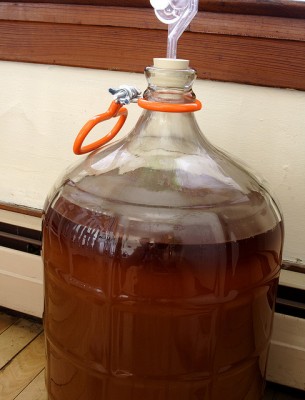
[3] Having no idea what a glass carboy was, I had to look it up (see picture on right, courtesy of this blog).  I've seen these before and knew that they were used in homebrewing, but I had no idea that it was called a carboy!  Wikipedia says that a carboy's capacity is typically five to fifteen gallons (that's 40 to 120 pints according to www.onlineconversion.com) and that they are also known as a demijohn (anyone else thinking about "Music Man" now, or is it just me?).
[4] Admittedly, I reference Tröegs' brews a lot.  What can I say?  I love 'em!  That being said, this comparison should speak volumes.