Wednesday, April 20, 2011

Chinese Beer Bags

Yes, you read that correctly.  In China, you can get fresh beer - in a plastic shopping bag from a street vendor!
He must be thirsty.
(Photo Courtesy of http://www.charchaa.com/only_in_china_beer_in_a_bag_pic)
A co-worker recently shared this information with me (thanks, Ben!).  He said that he actually witnessed this when he was in Qingdao, China on business.  When Ben asked his translator, "what's with the bags?", I don't think he was prepared for the answer.  Apparently, brewery workers are partially paid with beer, and they take their kegs to the streets.  People like it because of how fresh it is, so it is customary to see people walking the streets with their bags of beer.

I'll take a bag to go, please!
(Photo Courtesy of http://www.travelpod.com/travel-blog-entries/kyewix/2/1260735639/tpod.html)
Qinqdao is home to China's "largest and most prestigious" brewery, Tsingtao, which was founded by German settlers in 1903.  (I think there's a German phrase that goes something like, "Beer. Never leave home without it.")  Not only is it China's largest brewery, Tsingtao Lager is China's #1 consumer product exported from China.  (I think the exported beer is bottled though.)

Tsingdao Brewery
(Photo Courtesy of http://upload.wikimedia.org/wikipedia/commons/d/de/Tsingdao_Brewery.jpg)

So what do you do with beer in a bag?  I suppose you could take it home and transfer it to a mug, but that just doesn't seem like a whole lot of fun.  I mean, we're talking beer in a bag here.  I did a little bit of digging around on the Internet, and it appears that most people choose to consume their beer on the spot with a straw.

How do you drink beer from a bag?  One sip at a time.
(Photo Courtesy of http://www.travelpod.com/travel-blog-entries/brabzzz/2/1274923893/tpod.html)
While you may never find another place on earth that sells beer in a bag on the street, you don't have to travel all the way to Qingdao, China just to try their lager (#1 consumer product export, remember?).  I have not yet had the privilege, but the next time I see Tsingtao Beer somewhere, I think I'll have to try a bag glass.  Prost!
(Photo Courtesy of http://www.life.com/image/71715931)

Thursday, April 14, 2011

Alehoof, Ivy, and Hops


I have a desk calendar called "Forgotten English" by Jeffrey Kacirk, and there was an interesting entry for April 11th.  It was a word called "alehoof", which is apparently a botanical word.  Kacirk quotes Daniel Fennig's "Royal English Dictionary" (1775) which defines alehoof as "the ground-ivy [Glechoma hederacea], so called by the Saxons because a chief ingredient in their malt-liquor instead of hops".  Kacirk then talks about an interesting event called the Kent Hop Stringing Championship (see photo below).  He says:

"At this time of year, English hop plants begin to awaken from their fall and winter dormancy and need to be strung, allowing them to twine upward to heights of more than fifteen feet.
"Until the 1960s, a contest was held in Staplehurst, Kent, in which contestants secured the delicate hop shoots to poles for the title of Britain's Champion Hop Stringer.  Judges awarded points for speed and neatness based on the principles of the time-tested 'umbrella method,' in which string was run up to overhead wires and bound by a 'bander-in' worker forming a 'hill.'  Stilts were once employed by hopyard workers, but now most of the elevated work is handled with ten-foot-long poles tipped with piping, through which the string is fed.  Silver trophy cups were awarded to the winners, and pints of ale were distributed among all participants.
"Before the 1520s, which is when hops came to England from Holland, various bittering and flavoring herbs were used for beer, including dandelions, hay, pine needles, balsam, mint, tansey, wormwood, coriander, and even ivy."

Who knew??

Hop Stringing Competition
(Photo Courtesy of http://www.hoppingdowninkent.org.uk/gallery.php?collection=4&image=5 )

A Hop-Stringer Named Johnny Hook (Pseudonym Anyone?)
(Photo Courtesy of http://www.bygonebodiam.co.uk/Johnny%20Hook%20Stringing.htm)

Hop Stringing on Stilts
(Photo Courtesy of http://www.corbisimages.com/Enlargement/HU008651.html)

Wednesday, March 23, 2011

How Does Your Beer Measure Up?

Yes, believe it or not, you can actually measure your beer.  No, I'm not talking about "give me a tall glass".  I mean that when you want to describe a beer, there are three things you can talk about:
  1. Bitterness - International Bitterness Units (IBU)
  2. Strength - Alcohol By Volume (ABV)
  3. Color - Standard Reference Method (SRM)
Of course, this is all very technical, so after taking a gulp, you wouldn't say "yep, that had a IBU of 30".  IBUs, for example, are measured by using a spectraphotometer and solvent extraction.  That doesn't sound like something I'll be able to do without some intense training!  Actually, you can have a lab analyze the beer (for about $10) and provide you with the IBU.  One such lab is the actual organization that developed the IBU scale - they are called the American Society of Brewing Chemists (ASBC).  Yes, that's right - chemists.  Who knew that those "general education" courses you had to take in college could have actually have gotten you a job working with beer?!?  (Note to chemistry professors: you may get better performance from your students if you advise of this career path.) One last note about bitterness: the apparent bitterness of a beer is subjective to the drinker, not to mention that malt content often makes the beer taste sweeter. That being said, IBU is not necessarily a good measure of the beer's "hoppiness". (source)

The worldwide measurement of a beer's strength is ABV. With the right tool (a hydrometer, which measures the density of liquid), this is something you can measure and calculate easily - homebrewers do it all the time. (source)  A beer's ABV is typically between 4% and 6% but can range from 2% to 12%. (source)  For example, the Constanza that I tried at Iron Hill Brewery recently was 6.2% ABV, but the ever-popular seasonal brew from Troëgs called Mad Elf Ale has a staggering 11% ABV. (Some restaurants actually have a limit on the number of Mad Elfs you can order in a sitting!)  For a list of some common beers and their ABVs, check out http://www.realbeer.com/edu/health/calories.php.

Last is the color of beer.  The unit of measure, SRM, is an index value that speaks to the intensity of the beer's color.  The best way to describe this is by using a picture:

Chart courtesy of http://en.wikipedia.org (SRM)
For the exceptionally-interested reader, check out brewery.org/library/Color.html for more information about beer color measurement than you'll ever need to know.

So how do you measure a beer's taste?  It turns out that this is a unique, personal unit of measure which takes a lot of practice and years of honing.  Hope you're up to the challenge!  Prost!

(Main source: http://en.wikipedia.org/wiki/Beer_measurement)

Tuesday, March 15, 2011

Cheers!

So you may be wondering why I always end my postings with "zum Wohl!", and you may have guessed why.  It's a German phrase for "cheers!" that is literally translated as "to the health".  I was doing some reading online tonight and found out that "zum Wohl!" (pronounced "zoom vole") may be more commonly used in a formal setting when toasting with wine. The German word for "cheers!" that is more commonly used when drinking beer (in any setting) is "Prost!" (pronounced "proast") or its variant "Prosit!".  (Honestly, I knew this at one point.  I studied German for 8 years and minored in it in college, but when you don't use it, you lose it!)

For how to say cheers in just about any language you can think of, check out www.awa.dk or www.omniglot.com (includes some sound bytes of words pronounced in the native tongue). My favorite is Zulu: "oogywawa".

Thanks for reading - Prost!

Sunday, March 13, 2011

An Iron Hill Brewery Birthday Bash

My wife took me to Iron Hill Brewery for my birthday again this year - it's a perennial favorite of ours. I would say that it has the ambiance of a Houlihan's or Ruby Tuesday's but with a brewery attached. The menu is extensive, but I always gravitate toward the burgers. Of course, I enjoy trying some of their many beers. They have monthly-release beers as well as six house beers: Iron Hill Light Lager, Vienna Red Lager, Ironbound Ale, a seasonal Belgian Ale, Pig Iron Porter, and Raspberry Wheat. Over time, I've tried the red lager, the porter, and the wheat beers, not to mention the Belgian ale and other monthly releases. I have to say that the Raspberry Wheat is almost more of a "fruity beverage" than a beer. It had a good raspberry flavor, but I forgot I was drinking a beer!

During this particular visit to Iron Hill, I tried a total of five different beers:

1) Overload Stout (ABV 9.55%)


From the Menu: "This imperial Oatmeal Stout is brewed with locally roasted coffee beans and local Wilburs chocolate for an overload of flavor."

Tasting Notes: A full-bodied dark beer with lots of flavor and a bit of a bite; had a vanilla aftertaste / overtone. My wife (who is not a beer drinker) tried it and said she could really taste the chocolate and some coffee.


Overload Stout (served on nitrogen)
2) Russian Imperial Stout (ABV 9.5%)

From the Menu: "Full-bodied Stout that starts with a complex malty sweet and high roasted character that is wonderfully balanced with the generous use of citrusy American hops."

Tasting Notes: A strong, dark beer. Stouts and Porters seem very similar to me. (Consider researching the difference in a future blog post.)

3) Constanza (ABV 6.2%)

From the Menu: "This amber colored ale is brewed with a significant portion of rye malt and spiced with caraway seeds. A bready malt center with a dry spicy finish. Pairs nicely with the most 'sensual of the salt cured meats - pastrami.'"

Tasting Notes: A great flavor! Malt and caraway give this a good flavor, though not extremely strong. There is a light spice flavor - there is just enough to give it some zest, but it's not overpowering.

4) Cask-Conditioned Constanza

Tasting Notes: Warmer than the non-cask-conditioned version (i.e. it's not served cold). There is less of a spice flavor after the cask conditioning, though it is still very good. (Consider researching the reason for cask conditioning and what it is supposed to do for a beer in a future blog post.)


Samplers - Russian Imperial Stout and Constanza (Regular and Cask-Conditioned)
5) Bonzai (Seasonal Belgian Ale) (ABV 7.0%)

From the Menu: "This Belgian Saison is a collaboration beer brewed with our head chef Mario Romero, spiced with a variety of the kitchen's secret Asian spices."

Tasting Notes: "WOW!" That is exactly what I said after trying the first (and second, and third) sip of this powerfully tasty ale. It was literally a blast of flavor in my mouth! It had a citrusy flavor, but not a strong citrusy flavor. It was fizzy - my wife described it as being like a carbonated soft drink and tasting like a "Spree" candy. This was a really light-colored ale compared to other ales that I have tried (though the picture that I took and posted below makes it appear more yellow that it was). The best way to describe this drink: happy-tasting.


Bonzai (Seasonal Belgian Ale)
If you've never been to the Iron Hill Brewery, it's definitely worth visiting. Check it out - I'm sure you'll find it to be a real treat!

Zum Wohl!

Wednesday, March 2, 2011

Yuengling Bock is Back

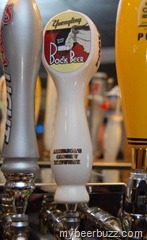
And man, is it good!  I tried some for the first time last night at Houlihan's in Hershey, PA and was quite impressed.  I heard of Yuengling Bock for the first time about a week ago and was immediately interested.  After doing some research, I was surprised to find out that Bock was only recently reintroduced by Yuengling.  In 2009, Yuengling made Bock again for the first time since the 1970s! (source)

If you followed any of the links I included in my last post, you may have run across the definition of Bock: it's the German term for a strong beer and likely indicates a bottom-fermenting brew made from barley malt (source).

Photo Courtesy of mybeerbuzz.blogspot.com

Yuengling's Lager is one of my all-time favorites, so I've been working on trying all of their brews.  If you like a dark beer, which I do, the Black & Tan is really good.  Bock is even better!  Bock is a seasonal brew, so if you're interested, you should plan on checking it out in the near future.  I definitely recommend giving it a try.

Zum Wohl!

Monday, February 21, 2011

A Beer is a Beer is a Beer

Except when it's a pilsner, lager, ale, porter, or stout! These are all beers, just different styles. I've always wondered what the difference was but never took the time to look it up. So here we go:

Any beer can typically be classified as either a lager or an ale (1). A lager is any beer made with bottom-fermenting yeast and may be golden or dark in color. Conversely, an ale is any beer made with top-fermenting yeast and typically has a "fruity" flavor. Lagers are cold-brewed for longish periods of time and are typically paler, drier, and less alcohol-tasting than ales. Ales are brewed at warmer temperatures for less time, are generally higher in alcohol, and are more robust and complex than lagers.

A pilsner ("pils" for short) is golden-colored beer made with bottom-fermenting yeast (which makes it a lager). This conventional strength beer is considered by some to be a "super-premium" quality (2).

A stout is an extra-dark top-fermenting beer made with highly-roasted malts (2).

A porter is a lighter-bodied version of the stout (2).

For other types of beers, check out this website: http://www.beerhunter.com/beerstyles.html.

Thanks for reading! Zum Wohl!

Sources:
1) http://www.answerbag.com/q_view/1639
2) http://www.dougcoppock.com/dougcoppock/beer.html